EE 194. Introduction to Nanorobotics
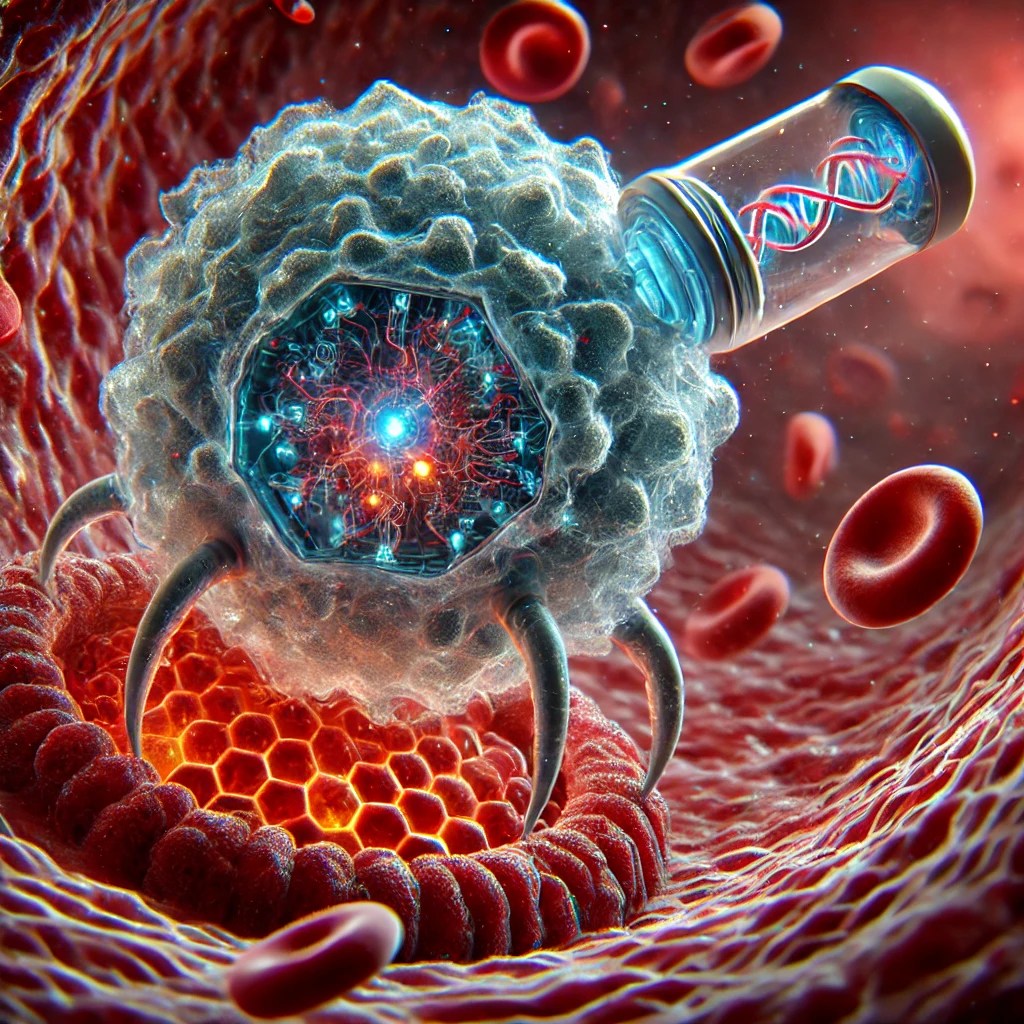
We cannot simply miniaturize a Roomba robot to clean up plaque in our arteries – the laws of the nanoworld are different from what we are used to. Nanorobotics is the discipline that investigates the challenges and opportunities of constructing and programming robots on nanoscale, and it holds the potential to transform science, medicine, and engineering. This emerging discipline is poised to address several emerging society needs, such as disease diagnostics and therapy. Students will learn engineering principles necessary to construct nanorobots.
- Week 1. Intro to nanorobotics
- Week 2. Types and functions of nanorobots
- Week 3: Nanorobot components
- Week 4. The “weird” physics of the nanoworld
- Week 5. Nanorobot construction approaches
- Week 6. Microfabricated robots
- Week 7. Biological machines
- Week 8. Micro- and nanomotors
- Week 9. DNA nanorobots
- Week 10. Nano-walkers
- Week 11. Cellular robots
- Week 12. Robot swarms
- Week 13. Future of nanorobotics
- Week 14. Project presentations
- Week 15. Project presentations
EE 143. Microfabrication Technology
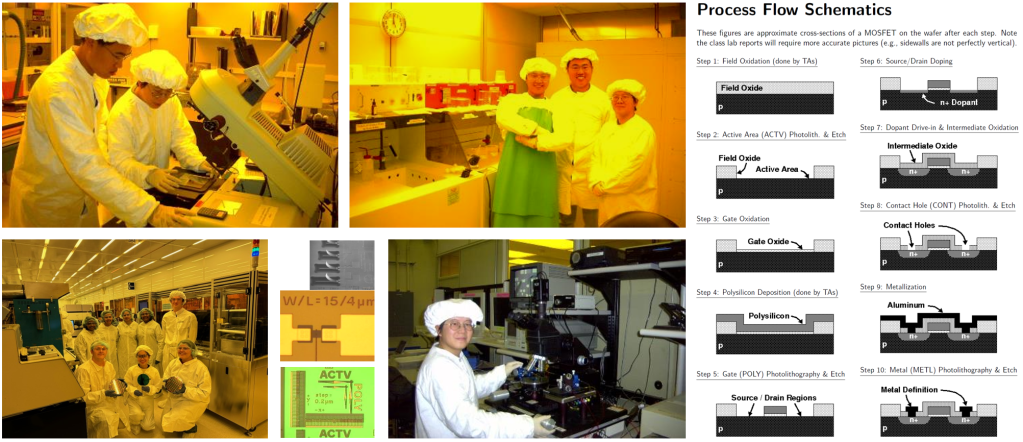
Integrated circuit device fabrication and surface micromachining technology. Thermal oxidation, ion implantation, impurity diffusion, film deposition, expitaxy, lithography, etching, contacts and interconnections, and process integration issues. Device design and mask layout, relation between physical structure and electrical/mechanical performance. MOS transistors and poly-Si surface microstructures will be fabricated in the laboratory and evaluated.
- Introduction to Devices and Processing (1-2 weeks)
- Photolithography (1 week)
- Etching (1 week)
- Oxidation (1 week)
- Deposition (1 week)
- Diffusion (1 week)
- Ion Implantation (1 week)
- Metallization/CMP (1 week)
- Simulation/Layout (1 week)
- Process Integration (1 week)
- Devices (2 weeks)
- Nanolithography and Nanofabrication (1 week)
EE C235. Nanoscale Fabrication
This course discusses various top-down and bottom-up approaches to synthesizing and processing nanostructured materials. The topics include fundamentals of self assembly, nano-imprint lithography, electron beam lithography, nanowire and nanotube synthesis, quantum dot synthesis (strain patterned and colloidal), postsynthesis modification (oxidation, doping, diffusion, surface interactions, and etching techniques). In addition, techniques to bridging length scales such as heterogeneous integration will be discussed. We will discuss new electronic, optical, thermal, mechanical, and chemical properties brought forth by the very small sizes.

1 Overview and Nanofabrication with photons
Nanofabrication with electrons and ions
2 Nanofabrication with scanning probe
Nano-imprint and soft lithography
3 Self-assembly with strong bonds
Self-assembly with weak bonds
4 Protein and DNA nanotechnology
Bionanotechnologies
5 Serial methods
Directed Self-Assembly
6 Precision placement and other techniques
Electron and probe microscopies
7 Solution-based techniques and optical nanoscopy
Tutorials: Top Down
8 Tutorials: Top Down
Tutorials: Top Down
9 Tutorials: Top Down
Tutorials: Bottom Up
10 Spring Break
Spring Break
11 Tutorials: Bottom Up
Tutorials: Bottom Up
12 Tutorials: Bottom Up
Tutorials: Integration
13 Tutorials: Integration
Tutorials: Integration
14 Tutorials: Integration
Project Presentation
15 Project Presentation
Project Presentation
16 Project Presentation
Project Presentation
 Ti Lab at Berkeley